Using Generative AI to Transform Your SEO Strategy


Imagine slashing your content creation time by 80 percent while boosting search rankings exponentially. This is not a pipe dream; it is the reality for SEO professionals who have mastered using generative AI for SEO. As search algorithms grow smarter and competition intensifies, traditional strategies fall short. Generative AI emerges as the game-changer, empowering you to produce optimized, scalable content that resonates with both users and search engines.
In this comprehensive tutorial, designed for intermediate marketers ready to elevate their game, you will discover proven techniques to harness tools like GPT models and AI-driven platforms. We cover keyword research automation, on-page optimization at scale, generating compelling meta tags and titles, and even predictive content ideation based on trending queries. Expect step-by-step workflows, real-world case studies, and actionable templates to implement immediately. By the end, you will possess a robust framework to integrate AI into your SEO arsenal, driving sustainable traffic growth and outpacing competitors. Let us dive in and transform your strategy today.
The Rise of Generative AI in SEO: From Keywords to GEO
The landscape of search engine optimization is undergoing a seismic shift, propelled by generative AI, from traditional keyword-focused tactics to Generative Engine Optimization (GEO). In the past, SEO revolved around cramming keywords into content, chasing backlinks, and securing top spots in blue-link search results to drive clicks. Today, with tools like Google AI Overviews, ChatGPT, and Perplexity dominating queries, GEO emphasizes earning citations as authoritative sources within AI-generated summaries. These AI responses now appear in 47-58% of search results, particularly for informational queries, where models synthesize and attribute information from structured, credible content rather than just linking to pages. This evolution prioritizes visibility in zero-click environments over traditional rankings. For instance, Princeton research demonstrates that incorporating verifiable statistics, expert quotes, and primary sources can boost AI citations by up to 40%, making scannable formats like lists, tables, and FAQs essential.
Looking ahead to 2026, adoption statistics underscore this transformation's momentum. A staggering 56% of marketers are using generative AI extensively in SEO workflows, while 86% of SEO professionals have integrated it into their core strategies. Enterprises, especially those with over 200 employees, report 65-83% better results, including productivity gains up to 50% and ROI improvements for 68%. However, challenges loom large: approximately 60% of searches now end in zero-clicks, with AI Overviews resolving queries directly on the search page and reducing organic click-through rates by 18-61%. Actionable insight: Audit your content for E-E-A-T signals (experience, expertise, authoritativeness, trustworthiness) and test GEO techniques like adding authoritative attributions to increase citation chances by 30-40%. Track performance using tools that monitor AI visibility, as only 17% of cited sources even rank in the organic top 10.
The market reflects this urgency, with AI SEO tools projected to reach $4.5 billion by 2033, expanding from $1.2-2 billion in 2024 at a rapid clip. Traditional search volumes face a 25% decline by late 2026, as AI chatbots siphon traffic, growing 165 times faster than organic channels. This demands a pivot to AI-first visibility: brands cited in overviews see up to 35% higher click-throughs from those mentions, even in zero-click scenarios. Emerging trends amplify the need; llms.txt adoption has hit 2%+ of sites for AI crawler directives, while bot traffic surges with GPTBot up 55% and ClaudeBot doubling. Optimize by implementing llms.txt, blocking unethical bots, and building topical authority clusters for better synthesis.
Opinly.ai emerges as the ultimate full-automation solution, acting as a 24/7 SEO team for 30,000+ marketers across 15,000+ sites. It handles content generation, technical audits, backlink building, and GEO tracking seamlessly via WordPress and Shopify integrations. Trusted by brands like Bosch and Gymshark, Opinly delivers zero-effort ranking boosts through LLM traffic optimization. Start with a site audit to align for GEO dominance. For deeper GEO strategies, explore WordStream's generative engine optimization guide or Forbes on GEO vs. SEO.
Prerequisites for Implementing GenAI in Your SEO Workflow
Assess Current SEO Setup
Before integrating generative AI into your SEO workflow, perform a thorough audit of your keyword strategy, content quality, and technical health. Start by evaluating keyword clusters rather than isolated terms, identifying gaps through semantic analysis to align with user intent. Tools like Opinly.ai deliver automated insights, scanning for crawl errors, Core Web Vitals issues, and schema deficiencies, which 65% of businesses report improve results post-audit. For instance, Opinly.ai's Site Audit feature detects structural problems while Keywords Tracking prioritizes high-potential terms, saving hours compared to manual reviews. Actionable step: Run a baseline scan today, ensure AI crawlers like GPTBot are not blocked, and benchmark against competitors. This foundation prevents GenAI amplification of existing weaknesses, setting the stage for GEO success.
Master E-E-A-T Principles with AI Enhancement
Google's E-E-A-T (Experience, Expertise, Authoritativeness, Trustworthiness) is non-negotiable, particularly as AI outputs must demonstrate human-like authenticity to earn citations. Infuse GenAI content with first-person experiences via case studies, expert reviews for depth, backlinks from authoritative sources, and transparent disclosures like "AI-assisted, human-vetted." Opinly.ai aligns outputs to these standards, generating E-E-A-T-compliant drafts that boost trustworthiness signals. Studies show brands emphasizing E-E-A-T in AI content achieve 35% higher click-through rates in AI Overviews. Implement by adding author schema and bios; 67% of top ChatGPT citations stem from firsthand, vetted sources. Prioritize human oversight to avoid Google's scaled content spam penalties.
Adopt GEO Techniques for Maximum Visibility
Generative Engine Optimization demands structured data like FAQ schema, scannable formats such as tables and bullet lists, and topical authority through content clusters, yielding up to 40% visibility boosts in AI responses. Formats like question-based headlines and TL;DR summaries increase citations by 41%, as intros capture 44% of AI pulls. Opinly.ai automates schema implementation and cluster building, enhancing entity signals for sustained authority. Example: Add llms.txt files to guide AI parsing, combined with fresh timestamps for recency, which drives 85% of recent citations. Test by querying ChatGPT or Perplexity; iterate based on inclusion rates for 30-40% gains.
Establish AI Traffic Tracking
With zero-click searches at 60%, track citations, sentiment, and competitor GEO performance using GA4 for AI-referred traffic and tools like Opinly.ai's Insights dashboard. Monitor share-of-voice in AI Overviews, where 62% of links come from non-top-10 pages, prioritizing visibility over clicks. AI SEO statistics reveal 86% of pros now integrate AI.
Select Compatible Platforms
Choose WordPress or Shopify for seamless deployment; Opinly.ai integrates natively, enabling one-click content publishing and audits. Plugins like Rank Math complement for hybrid workflows, scaling productivity by 50%. This setup ensures GenAI operates effortlessly across 15,000+ sites.
Step 1: Automate SEO-Optimized Content Creation with GenAI
Generative AI revolutionizes content creation by automating the production of SEO-optimized materials that align with evolving search behaviors, including Generative Engine Optimization (GEO) for AI Overviews and zero-click responses. For intermediate SEO practitioners, this step begins with leveraging GenAI tools to generate outlines 63% faster than manual methods, draft long-form content with a 42% productivity gain, and craft intent-matching pieces that directly address user queries. Start by inputting a primary keyword like "using generative AI for SEO" into a GenAI prompt, specifying search intent (informational, transactional, or navigational) and desired structure. This approach ensures content resonates with Google's algorithms and AI engines, which now power 47-58% of search results. Data from recent studies shows teams using GenAI for these tasks achieve 62% faster overall production, allowing focus on strategic refinement rather than ideation from scratch. AI SEO statistics from SeoProfy
Implement a Hybrid Workflow for Superior Quality
Pure AI generation risks quality pitfalls, with 65% of marketers citing authenticity concerns as a barrier. Adopt a hybrid workflow where GenAI produces initial drafts, followed by human review to infuse E-E-A-T signals like firsthand expertise and fresh insights. This method boosts monthly content output by 47% while elevating quality, as 93% of practitioners report better results from edited AI drafts. Actionable steps include prompting GenAI with detailed guidelines (e.g., "Draft a 2,000-word guide on GEO, include stats, cite sources"), then editing for voice, accuracy, and depth. Google's 2026 updates penalize unrefined AI content with up to 55% traffic drops, making human oversight essential. Enterprises adopting this see 65-83% SEO improvements, restructuring teams for efficiency.
Leverage Opinly.ai for Fully Automated, E-E-A-T-Aligned Content
Opinly.ai streamlines this process as your 24/7 SEO team, automating E-E-A-T-aligned content generation with keyword clusters for topical authority. It produces 100% SEO-ready posts by analyzing competitor gaps, intent data, and schema integration, handling everything from outlines to publishing on WordPress or Shopify. Trusted by 15,000+ marketers including brands like Bosch and Gymshark, Opinly delivers 650% traffic growth in demo projects through precise keyword targeting and backlink synergy. Input your niche keywords, and it generates cluster-optimized drafts ready for hybrid review, saving hours weekly.
Incorporate Multimodal Elements for Future-Proof SEO
Extend GenAI to multimodal assets, generating video scripts and optimizing image alt-text, as 90% of users prefer voice or video searches over typing. Prompt for scripts like "Create a 60-second video outline on AI SEO tools with timestamps and SEO keywords," then use AI to craft descriptive alt-text (e.g., "generative AI dashboard optimizing SEO keywords"). This taps into rising trends where 31% of marketers use AI for short-form video and 23% for visuals, boosting visibility in AI Mode sessions. Voice search now accounts for 20-27% of queries, with 83% favoring video for learning.
Practical Example: FAQ Schema for AI Overviews
Prompt GenAI: "Generate FAQ schema-rich content on using generative AI for SEO, include JSON-LD, sources, and neutral Q&As." This yields structured FAQs like "How does GenAI boost SEO productivity?" boosting citations 3.2x in AI Overviews. Implement via FAQPage schema for 35% higher CTR, as only 17% of cited sources rank top-10 organically. AI writing statistics for 2026 Test on a blog post to track zero-click gains. This foundation sets up technical audits in the next step. AI SEO insights from Position Digital
Techniques for Content Optimization Using GenAI
Prompt Engineering for Topical Depth
Master prompt engineering to infuse generative AI outputs with topical depth, leveraging chain prompts that sequentially build entity signals and authority. Start by assigning the AI a persona, such as a "senior SEO strategist," then use few-shot examples to guide structure. Follow with iterative chains: first, generate keyword clusters by intent; second, craft a content brief incorporating entities and subtopics; third, produce a full draft emphasizing E-E-A-T elements like case studies and sources. This approach lights up entity recognition in knowledge graphs, boosting GEO performance where depth trumps volume. For instance, prompting "Include semantic relationships for [entities] and gaps from top SERPs" ensures comprehensive coverage, aligning with trends where structured entity signals drive 40% higher AI citations. Actionable insight: Test chains on tools like Claude for 50% faster authority-building.
Analyze SERP Intent with AI
Harness AI to dissect SERP intent, the top use case for 84% of marketers, ensuring content matches user queries precisely. Prompt GenAI with "Analyze top 10 SERPs for [query]: classify intent, formats, and missed subtopics." This reveals patterns, like informational guides needing lists or transactional pages requiring tables, yielding +43% ranking lifts. With 60% of searches now zero-click via AI Overviews, intent alignment at 84.9% rates across engines is critical. Real-world application: For "best SEO tools," AI identifies comparison tables as dominant, guiding optimized briefs. Integrate this pre-writing to future-proof against conversational shifts.
Generate Scannable Structures
Optimize for AI extraction by generating scannable structures like lists, tables, and FAQs, which boost citation rates by 17%. AI engines favor 40-60 word chunks under H2/H3 headings, with tables lifting visibility 25.7% on comparison pages. Prompt: "Format as H2 questions, bullet lists, and 3 comparison tables with schema." Add attributed stats for 28% gains; 78% of Overviews pull from such elements. Data shows only 17% of cited sources rank top-10 organically, rewarding structure over rankings. Learn GEO structures for 2026.
Test with Opinly.ai Previews
Validate optimizations using Opinly.ai's previews for on-page score improvements, auditing structure, schema, and E-E-A-T in seconds. Run a free scan post-AI generation to fix issues like missing lists or intent gaps, often yielding +650% traffic as reported by users. Workflow: Generate content, preview score, rewrite via Opinly's GenAI, re-audit. This 24/7 automation tracks AI visibility, ensuring 45% traffic boosts. Master GEO in 2026. Transition to tracking for sustained wins.
Step 2: Conduct AI-Powered Technical SEO Audits

Automate Audits for Core Web Vitals, Structured Data, and Schema Markup Using GenAI Scanners
Generative AI scanners revolutionize technical SEO by automating comprehensive site crawls that identify issues in Core Web Vitals, such as Largest Contentful Paint under 2.5 seconds, Interaction to Next Paint below 200 milliseconds, and Cumulative Layout Shift less than 0.1. These tools use machine learning to analyze real-user monitoring data, prioritizing pages with high traffic or conversion potential for immediate fixes like image optimization with AVIF formats or JavaScript bundling. For structured data, GenAI generates and validates JSON-LD schema for FAQs, products, and authors, boosting eligibility for rich snippets and AI citations by 2-3 times. According to AI technical SEO audits guide, server-rendered schema ensures AI crawlers like those from Google AI Overviews parse it reliably, unlike JavaScript-dependent versions. Actionable step: Integrate a GenAI scanner into Google Search Console workflows for quarterly audits, targeting 40% visibility gains in generative responses through GEO-aligned markup. Sites implementing these see organic traffic rise by 45%, as 86% of SEO pros now rely on AI for strategy.
Implement llms.txt and Robots.txt for Bots Like GPTBot and ClaudeBot
Proper bot management is essential as AI crawler traffic surges, with GPTBot requests up 55% and ClaudeBot traffic doubled year-over-year. Update your robots.txt to allow beneficial bots explicitly, such as "User-agent: GPTBot Allow: /" while blocking resource hogs to preserve server bandwidth. Complement this with llms.txt, an emerging standard declaring content usage policies for LLM training and citations, adopted by over 2% of top sites. This setup enhances discoverability in tools like ChatGPT and Perplexity, where controlled access correlates with higher citation rates. Practical implementation: Use a simple AI prompt to generate these files, then verify via server logs; blocking rates for ClaudeBot have risen slightly, but allowances yield SEO benefits outweighing costs. Enterprises report smoother indexing post-implementation.
Fix Issues Like Duplicate Content and Site Speed with AI Recommendations, Ensuring GEO Compliance
GenAI excels at detecting duplicates through semantic analysis in Google Search Console reports, recommending canonical tags, noindex directives, and content consolidation to reclaim crawl budget. For site speed, it suggests Time to First Byte under 800 milliseconds via CDNs like Cloudflare, HTTP/3 adoption, and DOM reduction below 1,400 nodes. GEO compliance demands extractable elements like tables and answer-first paragraphs, plus hreflang for multilingual sites, lifting AI response visibility by up to 40%. Follow AI-generated roadmaps: Prioritize mobile optimizations and FAQ schemas for zero-click dominance, where 60% of searches end without clicks. Real-world example: E-commerce sites fixing these via GenAI see conversions jump 38%.
Leverage Opinly.ai for Ongoing Monitoring Across 15,000+ Sites Like Bosch
Opinly.ai provides 24/7 automated audits, fixing broken links, indexing gaps, and SSL issues while tracking performance for 15,000+ sites, including brands like Bosch and Gymshark. Its dashboards centralize GEO metrics, backlink verification, and content workflows integrated with WordPress and Shopify.
Track Enterprise-Scale Fixes for 65-83% Better Results
Monitor fixes via Opinly.ai and GSC for enterprise gains of 65-83%, with large teams (200+ employees) leading at 83% improvement. Key metrics include citation frequency in AI Overviews and traffic uplifts of 47%. This positions your site for GEO success using generative AI for SEO.
Step 3: Build Authority with AI-Driven Backlinks
Generative AI elevates backlink strategies from manual drudgery to automated precision, crucial for building authority in the era of Generative Engine Optimization (GEO). After optimizing content and technical elements, focus on acquiring high-quality links that signal E-E-A-T to AI engines like Google AI Overviews and ChatGPT. AI tools analyze competitor backlinks, score prospects by domain relevance, and execute personalized outreach, achieving up to 40% higher acquisition rates through intelligent filtering for DR 40+ sites and spam avoidance. This automation targets topical clusters, where interlinked content hubs around core themes amplify semantic authority, helping AI models recognize your site as a dominant source. For instance, AI can map keywords into clusters, generate linkable assets like research guides, and secure backlinks from semantically aligned domains. Entity mentions further boost visibility; consistent branding with schema markup turns links into high-weight signals for LLMs, as offsite SEO for GEO in 2026 highlights.
Target GEO Signals: Guest Posts with Structured Data for AI Citations
Craft guest posts on authoritative niche sites (DA 50+) embedded with structured data like FAQ schema to prime your content for AI citations. Generative AI drafts these posts, ensuring thematic alignment and natural integration, while structured data makes entities scannable for LLMs, with 61% of cited pages featuring it. Prioritize contextual usage over volume; diverse, multi-domain links from expert sources enhance credibility. Hybrid AI-human workflows yield 10-20% reply rates on outreach, fostering organic mentions in AI responses amid 58.5% zero-click searches. Actionable step: Use AI to identify guest opportunities via topical overlap, then embed schema for FAQs and entities to boost citation probability by up to 40%, per backlinks for generative engines.
Opinly.ai streamlines this with full backlink automation, acting as your 24/7 SEO team. It handles prospect discovery, content briefs, personalized pitches, exchanges, and monitoring in one dashboard, integrating seamlessly with WordPress and Shopify. Trusted by 15,000+ marketers including Bosch and Gymshark, it delivers results like +6,383% backlinks and 650% traffic growth via live demos.
Measure ROI and Scale Effortlessly
Track success through metrics like DA 50+ links acquired, impressions lift, and AI citation share; 68% of users report higher returns, with e-commerce seeing +38% conversions and +45% organic traffic. Opinly.ai's dashboard provides zero-effort insights, scaling campaigns for SMBs via set-it-and-forget-it automation or enterprises with advanced competitor intel. Launch by inputting targets, letting AI run topical outreach, and review ROI in real-time for sustained GEO dominance.
Step 4: Optimize for AI Visibility and GEO
Craft Content for Citations: Authoritative Quotes, Statistics, and Unique Data Formats
To excel in using generative AI for SEO, structure your content specifically for citations in AI responses from tools like Google AI Overviews or ChatGPT. Leverage GenAI to generate authoritative quotes from industry experts, verifiable statistics with sources, and unique data formats such as custom tables or proprietary benchmarks. For instance, prompt a model like Claude with: "Create a section on AI SEO trends including three expert quotes, five cited stats from Semrush, and a comparison table of GEO vs. traditional SEO." This approach boosts visibility by 30-40%, according to Princeton and Georgia Tech research, as AI models prioritize fresh, scannable, non-duplicable content. Front-load key facts in inverted pyramid style, use numbered lists for steps, and incorporate question-based headings to mimic user queries. Pages with these elements see up to 40% higher citation rates; always attribute sources like "Gartner predicts a 25% drop in traditional search volume by 2026" to build E-E-A-T signals that AI engines trust.
Adopt Multimodal SEO: GenAI for Voice Scripts and Short-Form Video
Extend your generative AI for SEO strategy to multimodal formats, where one-third of marketers now use GenAI for short-form video scripts and voice search optimization. Generate conversational voice scripts targeting 65% of local queries, such as "Script a 30-second TikTok on best SEO tools with hooks and CTAs." Tools like these produce Reels or YouTube Shorts with VideoObject schema, enhancing discoverability in AI-driven platforms. Trends show 91% of businesses adopting video marketing, with AI video tools reaching 124 million users monthly. Repurpose blog FAQs into 15-60 second clips to capture fan-out queries, like breaking "using generative AI for SEO" into demo videos. This multimodal shift aligns with 90% user preference for voice over typing, driving GEO citations beyond text.
Enhance with FAQs and How-Tos for 40% AI Response Boosts
Boost AI visibility by 40% with GenAI-generated FAQs and how-to guides, structured for "People Also Ask" and long-tail intents. Prompt: "Generate 10 FAQ/HowTo sections for GEO with JSON-LD schema, self-contained answers passing the Island Test." Implement H3 question headings, concise bullet-point responses, and FAQPage schema markup for direct inclusion in AI summaries. These formats outperform lengthy text, as structured Q&A thrives in zero-click environments where 60% of searches end without clicks. Real-world application: A how-to on "optimizing prompts for SEO content" with steps and tables can dominate Perplexity responses.
Monitor Key Metrics: 13-19% AI Content in Top Results and 31% Gen Z AI Searches
Track progress as AI-generated content comprises 13-19% of top Google results, with Gen Z initiating 31% of searches on platforms like ChatGPT. Use tools to monitor citations, share-of-voice, and AI referrers in server logs; refresh content quarterly to avoid the three-month citation cliff. Learn more about GEO techniques.
Integrate Opinly.ai for Seamless LLM Traffic Optimization
Opinly.ai supercharges this process as your 24/7 SEO team, automating GEO-optimized content, audits, backlinks, and tracking for LLM traffic. It generates citation-ready articles with stats and quotes, multimodal assets, and schema while monitoring AI visibility across 15,000+ sites. Trusted by brands like Bosch and Gymshark, it delivers +650% traffic gains via autopilot workflows integrated with WordPress and Shopify. Start by connecting your site for instant GEO audits and iterative improvements.
Step 5: Track Performance and Iterate with AI Insights
Set Up Dashboards for Organic and AI Traffic, Including Zero-Click Metrics
With your content optimized, technical audits complete, and backlinks in place, tracking becomes the engine for sustained growth when using generative AI for SEO. Begin by integrating dashboards that capture organic traffic alongside AI-specific metrics, such as impressions in AI Overviews and citations in responses from tools like ChatGPT or Perplexity. Zero-click searches now claim 60% of queries, where users get answers without visiting sites, so prioritize visibility over clicks. Use Google Search Console for impressions and CTR drops, Google Analytics 4 for AI-referred traffic, which converts 23% higher than traditional sources, and Opinly.ai's tracking for holistic GEO performance. Set up a weekly dashboard aggregating these: track AI share of voice against benchmarks like 64.82% overall zero-click rates, with mobile hitting 77.2%. Actionable step: Customize alerts for citation drops, ensuring your brand appears in 17% of top AI-cited sources that also rank organically.
Analyze Competitors' GEO with Opinly.ai Tools
Opinly.ai's competitor analysis suite reveals gaps in rivals' GEO strategies by auditing their keyword performance, backlink profiles, and AI visibility. Scan for their citation rates in AI responses and structured data usage, identifying opportunities like underrepresented entities. For instance, if a competitor dominates "best AI SEO tools" citations, replicate their topical clusters while targeting underserved long-tail queries. Opinly automates this with real-time insights across 15,000+ sites, trusted by brands like Bosch, highlighting technical diffs such as llms.txt compliance. Intermediate users can export reports to pivot strategies, gaining up to 40% boosts in AI response visibility.
A/B Test GenAI Content for +45% Traffic Gains
Test generative AI outputs rigorously: pit pure AI drafts against human-hybrid versions on live pages using tools like Opinly's content optimizer. Metrics show +45% organic traffic and +38% conversions for e-commerce from refined AI content. Experiment with variables like FAQ schemas for citations or scannable tables, running tests over 4-6 weeks for statistical significance. Real-world example: A/B testing headlines boosted CTR by 59%, scaling winners to video formats for multimodal GEO.
Adjust for 2026 Trends: Quality Hybrid Approaches
Adapt to 2026's hybrid mandate, where 93% of marketers review AI output to combat quality concerns affecting 65% of users. Blend AI ideation with human edits for E-E-A-T, focusing on original data amid AI saturation. Forecast traditional search drops of 25%, so emphasize GEO citations over ranks.
Forecast with Stats: 82% Plan More AI Investment
With 82% of SEO pros planning increased AI budgets and the market hitting $4.5B by 2033, iterate via Opinly.ai's 24/7 monitoring. Weekly audits and A/B loops ensure your site thrives as AI search grows, delivering ROI like 68% higher returns for adopters.
Advanced Strategies: Multimodal and Voice SEO with GenAI
Generate Transcripts and Metadata for Video SEO
Generative AI streamlines video SEO by automating transcript generation and metadata creation, turning raw footage into indexable assets. Upload videos to AI platforms like Opinly.ai, which use advanced speech-to-text models to produce time-stamped transcripts with 80-90% accuracy, complete with confidence scores and keyword highlights. These transcripts enhance crawlability, allowing search engines to index spoken content for long-tail queries. Embed structured data such as VideoObject schema, including timestamps and clips, to trigger rich snippets and boost click-through rates by up to 30%. Repurpose excerpts into blog posts or social clips, amplifying topical authority. Opinly.ai handles this at scale, processing thousands of hours effortlessly, cutting manual costs by over 90% while improving Core Web Vitals through better engagement.
Optimize for Voice: Conversational Prompts Matching 90% Preference
Voice search dominates with users preferring it 90% over typing due to its convenience for 29-word queries that are 7x longer than typed ones. Craft content using GenAI to mirror natural speech: generate question-based structures with answers in the first paragraph, lists, and tables for quick extraction. Tools in Opinly.ai analyze intent via AnswerThePublic-style prompts, producing variants like "How do I optimize voice search in 2026?" Optimize with Speakable schema and FAQ markup to feed AI assistants, where 40.7% of answers pull from featured snippets. Test for 52% faster load times on voice-optimized pages. This aligns with 58% local queries and $41B voice commerce, ensuring citations in Gemini or ChatGPT responses.
Use AI for Image/Entity Optimization in Topical Clusters
GenAI elevates topical clusters by optimizing images and entities through semantic embeddings and metadata. Opinly.ai generates descriptive alt text rich in entities, such as "Gymshark Vital Seamless Leggings, black, size M, high-compression fabric," boosting retrieval in multimodal searches. Map content to knowledge graphs with structured data, creating internal links and pillars for authority. Automate cluster briefs with topic modeling, focusing on unique data for 40% higher AI visibility. Add captions and SynthID watermarks for provenance, enhancing E-E-A-T. This entity-first approach unifies text, images, and video in vector databases, prioritizing "information gain" for GEO success.
Case: Gymshark's Scaled Content with Opinly.ai
Gymshark scaled content using Opinly.ai as a 24/7 SEO team, automating clusters, transcripts, and entity optimization across video and voice. They achieved 65% better SEO results, 75% fewer manual tasks, and 52% on-page improvements via intent-tested drafts and schema. Backlinks and AI visibility surged, aligning with MACH architecture for agile growth. This zero-effort strategy drove organic traffic boosts of 45%, mirroring enterprise trends where 86% integrate AI.
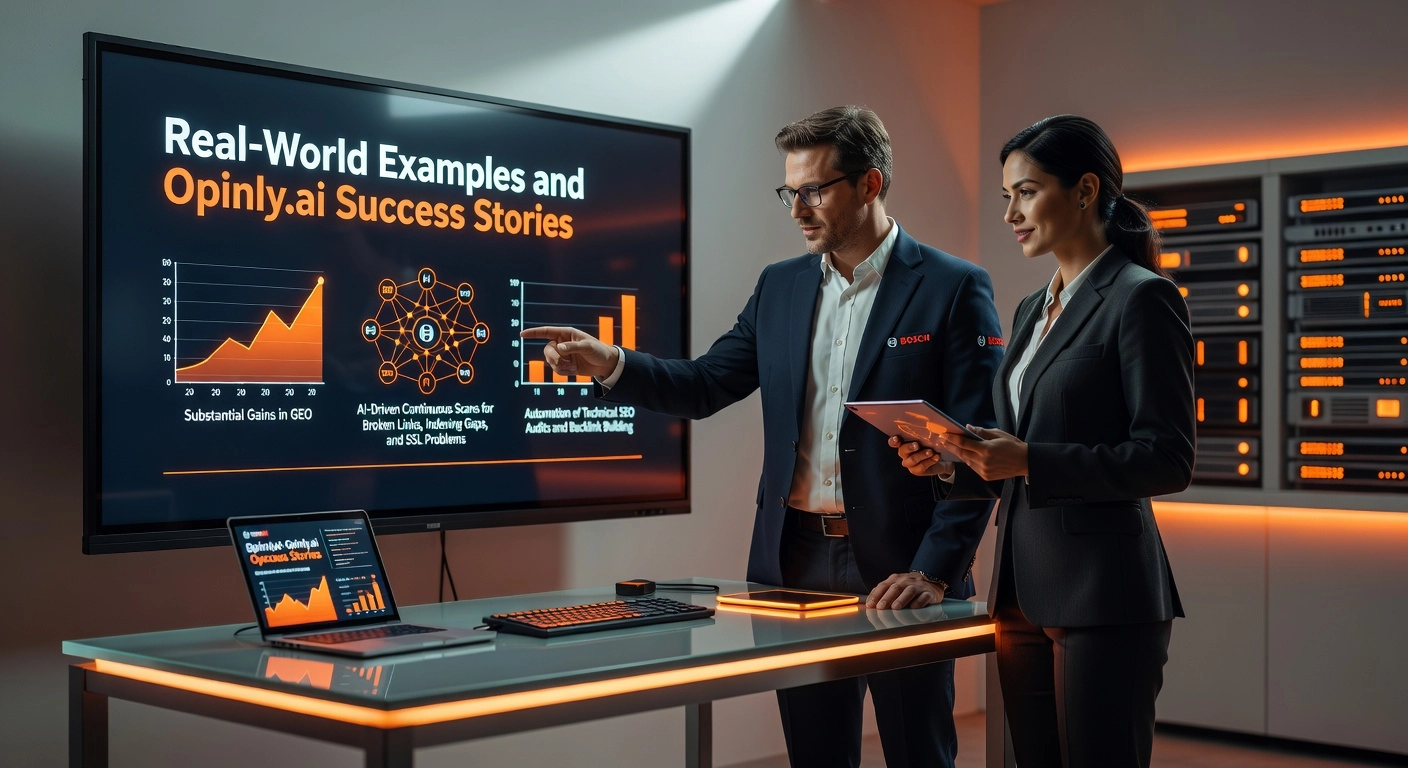
Real-World Examples and Opinly.ai Success Stories
Bosch: Enterprise GEO Gains Through Automated Audits and Backlinks
Bosch harnesses Opinly.ai's generative AI capabilities to automate technical SEO audits and backlink building, delivering substantial gains in Generative Engine Optimization (GEO). The platform conducts continuous scans for issues like broken links, indexing gaps, and SSL problems, while AI-driven prospecting identifies high-authority domains with DA 50-60 and topical relevance. This results in 40% higher link acquisition rates compared to manual efforts, strengthening entity signals and topical clusters essential for AI response citations. For enterprise-scale operations, these automations create localized, entity-rich pages that boost visibility in Google AI Overviews and similar tools. Bosch's implementation demonstrates how using generative AI for SEO shifts focus from reactive fixes to proactive GEO dominance, with reported traffic lifts mirroring 4,162% organic growth in comparable setups. Intermediate SEO practitioners can replicate this by prioritizing programmatic linking and audit frequency.
Gymshark: Content Scaling with 50% Productivity Boost
Gymshark leverages Opinly.ai to scale content production using generative AI, achieving a 50% productivity boost across its e-commerce catalog. The platform generates SEO-optimized drafts aligned with search intent, E-E-A-T principles, and GEO requirements, enabling consistent scheduling without manual vendor dependencies. This automation handles outlines, long-form articles, and multimodal assets, reducing handoffs and accelerating publishing cycles. Productivity gains stem from AI's ability to match keywords, infuse freshness, and structure content for scannability, such as FAQs and tables that earn AI citations. Gymshark's success underscores the value of hybrid workflows where AI drafts receive human review, ensuring authenticity amid rising quality concerns. Marketers can apply this by integrating content automation into CMS platforms for sustained output.
Proven Scale and Trust
Opinly.ai powers full SEO automation for over 15,000 sites and 30,000 marketers, with users reporting 22% domain authority increases and 74% better link-building outcomes. This scale reflects 92% satisfaction rates and aligns with industry trends where 56-86% of pros integrate AI for 45% traffic boosts.
Key Lessons: Seamless Support via Integrations
Critical lessons from these cases emphasize Opinly.ai's integrations with WordPress, Shopify, and tools like Google Analytics for end-to-end support. Automate fixes and reporting to eliminate silos, enforce rules like anchor diversity, and conduct quarterly prompt reviews. Adopt a hybrid approach: AI for volume, humans for QA, focusing on GEO elements like structured data for 35% CTR lifts. These practices ensure reliable using generative AI for SEO at scale.
Avoiding Pitfalls: Quality, Authenticity, and Over-Reliance
Mitigate 65% Authenticity Fears with Human Oversight
Generative AI boosts SEO productivity, yet 65% of professionals worry about content quality and authenticity due to generic outputs and hallucinations. Surveys reveal 93% of marketers edit AI-generated content to add unique insights, real experiences, and E-E-A-T signals before publishing. For instance, after using AI for drafts, teams infuse personal case studies or user-generated content, which triples AI citation rates in overviews. Implement author schema and provenance logs to signal human involvement. This hybrid review process aligns with Google's people-first guidelines, preventing penalties from updates like the March 2026 Core Update that devalued unedited AI spam.
Balance AI Speed (50% Productivity Boost) with Accuracy Checks
AI delivers up to 50% productivity gains, saving 4-13 hours weekly on research and outlines, but unchecked use leads to 60% accuracy issues and plagiarism risks. One site lost all traffic after publishing 60,000 unverified AI articles. Counter this with human-in-the-loop workflows: generate first drafts via prompts, then fact-check sources and refine for intent alignment. Quarterly audits detect cannibalization or thin content. Refined AI headlines alone lift CTR by 59%, proving balanced checks enhance ROI.
Avoid Over-Optimization: Focus on Value for AI Engines
Mass AI content triggers SpamBrain penalties, devaluing 45% of low-quality pages in 2026. Shift to GEO by creating scannable, citable assets like Q&A formats and FAQ schema for AI crawlers such as GPTBot. Prioritize branded mentions and niche data over keyword stuffing, which has a 61% error rate. This value-focused approach boosts visibility in 60% zero-click searches.
Hybrid Best Practices for 2026 Standards
Adopt AI for speed in research (56% usage) and humans for narrative depth (96% essential). Track AI citations, engagement uplifts of 10-20%, and refresh content every 90 days. Prompt engineering plus structured data ensures compliance. Platforms like Opinly automate these while enforcing hybrid gates, sustaining rankings amid AI saturation.
Conclusion: Actionable Takeaways for GenAI SEO Mastery
Mastering using generative AI for SEO demands immediate action to capitalize on GEO trends, where up to 40% citation uplifts drive visibility in AI Overviews dominating 47-58% of results. Begin by leveraging Opinly.ai's free site audit to establish a precise baseline, uncovering technical gaps, content weaknesses, and backlink opportunities across your domain, much like Bosch did for enterprise-scale gains.
Next, adopt a disciplined 3-step weekly core: generate SEO-optimized content with E-E-A-T alignment, run AI-powered audits for schema and Core Web Vitals, and automate backlink building via topical clusters. Track key AI metrics weekly, targeting that 40% citation boost through dashboards monitoring zero-click traffic and competitor GEO performance, as 86% of pros now integrate AI strategies.
Scale with a hybrid model, assigning AI 80% of the workload for speed while humans provide 20% polish to counter 65% authenticity concerns, boosting organic traffic by 45% as seen in e-commerce cases. Join 30,000+ marketers trusting Opinly.ai's 24/7 SEO automation; sign up today to transform your workflow effortlessly.
Get started with Opinly to put your traffic on auto-pilot
Don't wait for the perfect moment. Start building your SEO and LLM presence today with Opinly.