Best AI Tools for SEO Content Generation Ranked by Use Case
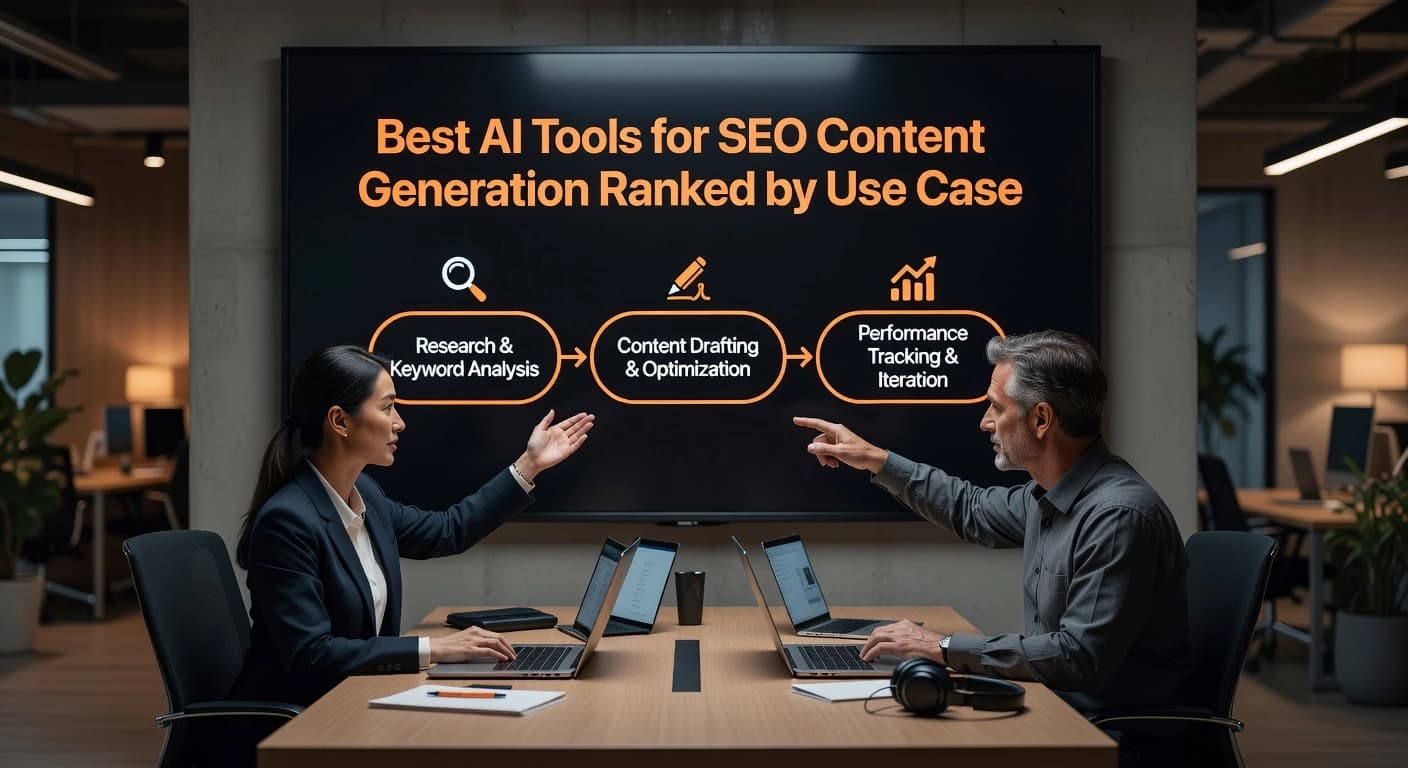
Not all AI writing tools are created equal, and choosing the wrong one for your SEO workflow can cost you rankings, time, and money. If you have been searching for which AI tool is best for SEO content generation, you already know the market is flooded with options, each claiming to outperform the rest.
The truth is, the best tool depends entirely on what you are trying to accomplish. Generating long-form blog posts, optimizing existing content, building topical authority, or scaling product descriptions each demand different capabilities from an AI platform. A tool that excels at one use case may fall completely flat at another.
In this comparison, we cut through the noise and rank the top AI tools based on specific SEO content generation scenarios. You will learn how each platform handles keyword integration, content structure, search intent alignment, and overall output quality. Whether you are managing a content team or running a solo operation, this guide gives you the clarity to make a smarter, more strategic choice for your SEO goals.
Why Choosing the Right AI SEO Tool Matters in 2026
The search landscape has shifted dramatically, and the tools you choose to navigate it will determine whether your content earns visibility or disappears into an increasingly crowded digital void. Approximately 60% of Google searches now end without a single click to any external site, with Google AI Overviews appearing in 25 to 47% of all queries and reaching over 2 billion monthly users. This means traditional organic rankings alone no longer guarantee traffic, and content strategies built around legacy metrics are quietly losing ground every single month.
The rise of LLM-powered discovery compounds this challenge significantly. AI search traffic grew 527% year-over-year, transforming platforms like ChatGPT, Perplexity, and Gemini into parallel discovery channels that operate entirely outside Google's ecosystem. Earning a citation in an AI-generated response now carries measurable strategic value, introducing a new performance metric called Generative Engine Optimization (GEO) that most legacy tools simply cannot track or optimize for.
Against this backdrop, 86% of SEO professionals now integrate AI into their daily workflows, yet the tool market has fragmented sharply. Pure content writers, standalone on-page optimizers, and full-stack automation platforms all promise results but serve fundamentally different needs. Choosing the wrong category means paying for overlapping subscriptions, manually bridging gaps between generation and technical optimization, or missing GEO visibility entirely while competitors earn AI citations you never knew existed.
This comparison evaluates tools across six criteria that reflect what actually drives results in 2026: content generation quality, on-page optimization, backlink automation, GEO and LLM tracking, CMS integration, and pricing tiers. Each dimension reveals where different tools excel and where they fall short, so you can make a decision grounded in capability rather than marketing copy.
How AI SEO Tools Are Categorized: Generation vs. Optimization vs. Full Automation
Not all AI SEO tools are built the same, and conflating these categories is one of the most expensive mistakes marketers make. Understanding the three distinct tiers helps you invest strategically rather than reactively.
Pure content generators like Jasper and Writesonic prioritize speed, brand voice consistency, and multi-format output. They can produce 2,000-word drafts in minutes and handle everything from blog posts to ad copy. The critical limitation is that fluency does not equal rankability. These tools are largely disconnected from live SERP data, NLP term scoring, and competitor gap analysis, meaning the content they produce often requires a separate optimization layer before it has a realistic chance of ranking. Teams relying solely on generators frequently publish polished content that underperforms because structural and semantic signals are missing from the start.
Content optimization and briefing tools like Surfer SEO, Clearscope, and Frase occupy the opposite end of the spectrum. They excel at analyzing top-ranking pages, generating data-driven briefs, and scoring drafts against NLP benchmarks. According to current research on AI SEO workflows, these tools provide the competitive intelligence that generators lack. However, they do not produce publishable drafts at scale on their own, making them dependent on a separate writing layer to complete the content pipeline.
Full-stack automation platforms like Opinly.ai close this gap entirely. Rather than patching together generators and optimizers, these platforms handle research, generation, optimization, publishing, backlink building, and performance tracking inside a single workflow. This integrated approach is why leading SEO tool analyses for 2026 increasingly favor comprehensive platforms for agencies and scaling teams.
Choosing the wrong category creates real financial consequences. Overpaying for automation you never deploy wastes budget; underinvesting in optimization silently costs rankings. Notably, 65% of SEO professionals report measurably better results after adopting AI, but that ROI depends entirely on matching the tool category to your actual workflow requirements and team size.
AI SEO Tool Comparison at a Glance
Most AI SEO tool roundups evaluate content generation and on-page optimization, then stop. They routinely omit two dimensions that are rapidly becoming non-negotiable in 2026: backlink automation and GEO/LLM tracking. As recent analysis of leading AI SEO tools confirms, these gaps force teams into manual handoffs between platforms, creating workflow friction and inconsistent results.
The table below maps nine tools across six critical dimensions so you can filter by capability and budget before reading individual reviews.
Tool | Content Gen | On-Page Opt | Backlink Automation | GEO/LLM Tracking | CMS Integration | Pricing Tier |
|---|---|---|---|---|---|---|
Opinly.ai | Yes | Yes | Yes | Yes | Yes | Budget/Mid |
Surfer SEO | Yes | Yes | Partial | Partial | Yes | Mid ($89+/mo) |
Clearscope | Limited | Yes | No | Limited | Yes | Mid ($129+/mo) |
Writesonic | Yes | Yes | No | Partial | Yes | Budget ($49+/mo) |
SE Ranking | Yes | Yes | Analysis only | Yes | Yes | Budget ($50+/mo) |
Frase | Yes | Yes | No | Partial | Yes | Mid |
AirOps | Yes | Partial | Limited | Yes | Yes | Mid/Enterprise |
Ahrefs | Limited | Yes | Analysis only | Partial | Yes | Mid/Enterprise |
Semrush | Yes | Yes | Analysis only | Yes (add-ons) | Yes | Enterprise ($129+/mo) |
The pattern is clear. Most tools cover two to four dimensions competently, then require you to switch platforms for the rest. A team using Clearscope for content grading, a separate outreach tool for backlinks, and a standalone GEO visibility tracker is managing three subscriptions, three datasets, and three learning curves. According to expert consensus in 2025-2026 tool evaluations, this fragmentation is the primary reason teams underperform despite using individually strong tools.
Opinly.ai is the only platform in this comparison covering all six dimensions simultaneously within a unified, automated pipeline. From AI content generation and on-page fixes through backlink exchange automation, LLM visibility tracking, and direct CMS publishing, everything runs without manual handoffs. For budget-conscious teams, that consolidation also eliminates the stacked subscription costs that make enterprise-grade coverage prohibitively expensive on modular stacks.
Opinly.ai: Best for Zero-Effort Full-Stack SEO Automation
Where most AI SEO tools force you to stitch together separate solutions for content, technical audits, link building, and rank tracking, Opinly.ai operates as a single automated engine that handles the entire pipeline without manual handoffs between stages. From initial keyword research and content brief generation through AI-driven article creation, CMS publishing, technical site auditing, and backlink acquisition via its automated exchange network, every stage runs continuously in the background. This end-to-end coverage is precisely what separates a full-stack automation platform from the point solutions that dominate most comparison lists.
Complete Pipeline Without the Tool Stack
The practical implication of this architecture is significant for teams operating at scale. Rather than exporting a Surfer SEO brief to a writer, then manually submitting link requests through an outreach tool, then logging into a separate rank tracker each week, Opinly consolidates every workflow into a single dashboard. Its AI-powered content optimization and automation layer is designed to sustain the kind of content velocity that modern SEO demands. Research consistently shows that companies using AI-assisted workflows publish 47% more content monthly on average, and Opinly's automation is built to maintain that output level without requiring additional headcount or additional subscriptions.
GEO and LLM Visibility Tracking
One capability that genuinely distinguishes Opinly from most tools in this category is its tracking of visibility within AI-generated answers. As Google AI Overviews now appear in 25 to 47% of queries and LLM-driven search traffic has grown 527% year over year, earning citations in ChatGPT, Perplexity, and Gemini results has become a parallel performance metric alongside traditional rankings. Opinly tracks these impressions directly, giving marketers measurable data on their Generative Engine Optimization (GEO) performance, a capability largely absent from point solutions focused solely on organic rank positions. The platform's approach to automated SEO and link building also reinforces this, since quality backlinks are cited by 73% of experts as a factor that improves AI citation rates.
Who It Is Built For
Opinly is trusted by 15,000+ marketers and enterprise brands including Bosch and Gymshark, demonstrating that its automation scales across both high-volume agency environments and complex in-house operations. For agencies managing dozens of client sites, growing brands without dedicated SEO staff, and in-house teams that cannot justify hiring multiple specialists, the platform effectively functions as a 24/7 SEO operation. Pricing is structured as a consolidated alternative to independently subscribing to a content optimization tool, a dedicated AI writer, a backlink prospecting platform, and a rank tracker, making the total cost of ownership considerably more manageable than running parallel subscriptions. Teams that need breadth of coverage without the operational overhead of managing multiple vendor relationships will find Opinly's full-stack SEO automation the most practical fit among the tools evaluated in this comparison.
Surfer SEO: Best for SERP-Driven On-Page Optimization
Surfer SEO has built a strong reputation as the go-to tool for content teams that need precise, data-driven on-page guidance. Its core Content Editor scores drafts in real time against the top-ranking pages for any target keyword, analyzing NLP signals, semantic entities, keyword density, heading structure, and word count benchmarks simultaneously. Rather than offering vague advice like "add more keywords," Surfer surfaces specific terms drawn directly from competitor content, along with quantitative targets that tell editors exactly what needs to change. This level of granularity is what separates Surfer from tools that generate content without grounding recommendations in actual SERP data.
Independent reviews and usability tests published in 2025 and 2026 consistently position Surfer as the gold standard for on-page content optimization, earning ratings between 4.4 and 4.7 out of 5 across feature and performance evaluations. The tool's reputation is backed by measurable outcomes: pages optimized with Surfer were reportedly twice as likely to reach the top 10 within 30 days, and users saw an average 423% growth in search visibility in 2025. For content teams that prioritize accountability and reproducible results, these correlations matter.
The AI Outline Builder adds another layer of precision by generating structured content plans, including headings and questions to answer, based on live SERP analysis rather than generic templates. Combined with the Content Score system, editors receive a clear, quantified target to work toward, with progress tracked dynamically as they write. This makes optimization feel like a guided process rather than guesswork, which is particularly valuable for teams managing high content volumes.
That said, Surfer has meaningful gaps worth acknowledging. It does not include backlink automation or advanced GEO tracking as core capabilities, meaning teams chasing LLM citation visibility or link-building scale will need to supplement it with additional tools. Some reviewers also flag query limits on lower-tier plans and cumulative pricing as practical constraints.
Best for: Content teams and agencies that already have an established drafting workflow and need a reliable, data-backed optimization layer to consistently lift content into competitive SERP positions. If your gap is on-page precision rather than full-pipeline automation, Surfer delivers well-documented, measurable results without unnecessary complexity.
Writesonic: Best for Fast, Customizable Content Workflows
Writesonic operates as a genuinely unified content platform, pulling research from 100+ sources, generating structured long-form drafts, scoring them against live SERP data, and pushing finished content directly to WordPress, all without forcing you to leave the editor. Its built-in SEO Checker integrates signals from Google Search Console, Ahrefs, and similar tools to surface competitor-aware keyword suggestions, readability gaps, and one-click refinements during the drafting process. For teams that lose hours each week to context-switching between separate research, writing, and optimization tools, this consolidated workflow delivers measurable efficiency gains. Users in 2025 report saving seven to ten hours weekly on SEO content tasks, and the platform's G2 rating sits at approximately 4.7 out of 5 across thousands of verified reviews.
Beyond traditional blog content, Chatsonic and Botsonic expand Writesonic's footprint into conversational AI applications that most pure-play content tools cannot match. Chatsonic functions as a multi-model interface supporting GPT-4o, Claude, Gemini, and others, with real-time web access and multimodal input handling. Botsonic enables no-code chatbot creation trained on your own site data, reportedly automating around 70% of customer support queries for active users. These features make the platform genuinely useful for marketers who need ad copy, product descriptions, and customer engagement workflows alongside their SEO content pipeline.
Where Writesonic shows measurable constraints is in GEO depth. It does offer brand visibility tracking across ChatGPT, Perplexity, Google AI Overviews, and Gemini, with share-of-voice metrics and competitor benchmarking included. However, 2026 analyses consistently note that these capabilities remain surface-level relative to platforms built specifically around LLM visibility optimization. Full GEO functionality is also gated behind Professional-tier plans priced at $249 per month or higher, which narrows its accessibility for budget-conscious teams.
Best for: Solo marketers and small content teams prioritizing fast, high-volume output over deep technical SEO or specialized GEO analysis. Writesonic delivers strong practical value at accessible entry pricing, but teams with serious LLM visibility goals will likely need a more purpose-built solution to complement it.
Clearscope: Best for Semantic Depth and Content Quality
Clearscope occupies a distinct and well-defined lane in the AI SEO tool landscape: it is not a content generator, not a publishing autopilot, and not a link-building engine. What it does deliver is arguably the most sophisticated semantic content optimization layer available for editorial teams that already have writers and want to raise the quality ceiling on every piece they publish.
At its core, Clearscope uses Google Cloud Natural Language Processing alongside additional NLP models to analyze top-ranking pages for a target query. Rather than simply counting keyword occurrences, it surfaces semantically related terms, entities, and concepts that reflect how comprehensively top content addresses a topic. This approach identifies coverage gaps by comparing a draft against competitive benchmarks in real time, grouping terms into color-coded clusters and flagging related questions and intent signals that lighter tools routinely overlook. The result is guidance rooted in meaning and topical completeness, not just surface-level keyword density.
Enterprise content teams at organizations prioritizing topical authority and E-E-A-T compliance have adopted Clearscope precisely because it reinforces thoroughness over speed. Customers including Shopify, Adobe, and Webflow have reported organic traffic lifts ranging from 52% to 130% by following its recommendations for more comprehensive, entity-rich pages. For teams where content quality is a competitive differentiator rather than a volume play, that depth of semantic guidance has measurable value.
The workflow integration is notably clean. Clearscope's real-time letter-grade scoring system connects directly with Google Docs via a browser extension and integrates with WordPress through a dedicated plugin. Writers receive live feedback inside familiar environments without context-switching between platforms, which reduces friction and accelerates adoption across teams regardless of SEO experience level.
It is important to be clear about what Clearscope does not do. It does not generate full drafts autonomously, handle technical SEO audits, or build backlinks. Teams needing those capabilities will need to supplement Clearscope with additional tools or consider a full-stack platform.
Best for: editors and content strategists at mid-size to enterprise brands who want to raise the quality floor on existing publishing workflows without replacing human creative judgment.
Frase: Best for Research-Heavy Content Briefs
Frase approaches SEO content creation from a fundamentally different starting point than the tools covered earlier in this comparison. Rather than prioritizing output speed or on-page scoring, it front-loads the process with structured research, pulling SERP data, competitor outlines, People Also Ask results, and forum-sourced questions from platforms like Quora and Reddit before a single sentence is drafted. Users input a target keyword and Frase scans the top-ranking results, extracting recurring headings, content gaps, average word counts, and topic clusters into a shareable brief that freelancers or junior writers can act on immediately. For agencies managing distributed writing teams, this capability alone eliminates hours of manual competitor analysis per assignment.
2026 reviews and tool roundups consistently position Frase as a strong mid-market option, particularly for content managers and strategists who treat the briefing stage as a competitive advantage rather than an afterthought. With a G2 rating around 4.8 out of 5 from over 500 reviews and a 98% recommendation rate, the platform has earned genuine credibility among teams that prioritize research quality and writer alignment over fully automated publishing pipelines. Agencies using Frase report significant productivity gains by standardizing brief quality across all contributors, reducing revision cycles, and ensuring every piece addresses documented search intent before drafting begins.
The included AI writing assistant drafts from outlines and expands sections, but it is designed as a complement to the research foundation rather than a standalone generator. Output benefits from human editing for accuracy, brand voice, and fact verification, which fits naturally into hybrid workflows where AI accelerates momentum without replacing editorial judgment.
Where Frase shows clear limitations is outside its research-and-brief core. It does not offer native backlink automation, comprehensive technical site auditing, or the kind of GEO tracking that monitors citation visibility across ChatGPT, Perplexity, and similar platforms. Teams working within a broader SEO stack will need dedicated tools to cover those gaps. Frase functions best as a precision instrument for the research-to-brief-to-optimize workflow, not as a replacement for a full SEO platform like Opinly.ai, which handles content, audits, backlinks, and performance tracking under a single automated system.
Best for: Content managers and strategists at agencies who regularly brief freelancers or junior writers and need structured, data-backed documents that standardize research quality at scale.
Rankability: Best for Accuracy and Agency Price-to-Value
Rankability takes a technically differentiated approach to content optimization by combining two separate NLP engines rather than relying on a single model. Its Content Optimizer simultaneously draws on IBM Watson NLP and Google's Natural Language API to extract entities, topics, and semantic signals from top-ranking competitor pages, then uses that dual-layer analysis to generate a real-time content score on a 0 to 100 scale. As users write or revise within the platform editor, the score updates continuously, surfacing exactly which concepts need reinforcement and which are already well-covered. This approach produces more reliable optimization signals than tools built on a single NLP layer, because each model captures different aspects of semantic relevance, and the combined output aligns more closely with how Google's own algorithms evaluate topical authority and meaning.
What separates Rankability further from self-serve alternatives is the expert coaching bundled directly into every paid plan. Subscribers gain access to Rankability Academy, a structured training library, alongside weekly live mastermind calls hosted by the platform's founders. For boutique agencies adopting a new optimization workflow across client accounts, this removes the adoption friction that typically comes with switching tools. Rather than consulting external guides or raising support tickets, teams get direct strategic input from practitioners who built the system. User reviews from 2025 and 2026 consistently highlight this hands-on access as a genuine differentiator, particularly for smaller agencies that want guided implementation without paying separate consulting fees.
In independent comparisons published through 2025 and 2026, Rankability performs strongly against both Surfer SEO and Clearscope on accuracy and price-to-value, particularly in agency-specific evaluations. Plans start around $199 per month for core tiers, which is competitive given the bundled coaching, white-label reporting, and multi-platform tracking that covers Google, ChatGPT, Perplexity, and Gemini visibility through a single proprietary score.
It is worth noting what Rankability does not cover. The platform concentrates on keyword research, AI-powered briefs, content scoring, audits, and post-publication monitoring. It is not a full-pipeline generation tool and includes no backlink management capabilities. Teams that need end-to-end automation from brief through to link acquisition will need to supplement it with additional tools. Best for: boutique agencies and SEO consultants who prioritize high-accuracy NLP scoring, value expert-guided adoption, and want strong price-to-value at the mid-market tier without stretching to enterprise-level contracts.
Jasper: Best for Brand-Voice Marketing Copy
Jasper occupies a clearly defined position in the AI content tool landscape: it is a brand-voice generation platform first, and an SEO tool a distant second. Its standout Brand Voice feature allows marketing teams to train the AI by uploading existing content, style guides, and website URLs, building reusable voice models that enforce consistent tone, grammar, punctuation, and style across every output. This matters enormously for large teams managing multiple writers, campaigns, or regional markets simultaneously. According to Jasper's own 2025 usage data, users created over 69,500 unique Brand Voices, a figure that underscores how central this feature has become to high-volume content operations. Setup reportedly takes under ten minutes and delivers 80 to 90 percent voice accuracy on subsequent outputs, substantially reducing editorial review cycles.
Where Jasper shows clear limitations is in SEO depth. Its SEO mode provides basic keyword targeting, typically through a Surfer SEO integration rather than native functionality, offering suggestions and scoring within the editor. However, this falls noticeably short of the real-time NLP-driven scoring, semantic grading, and SERP structure analysis available in dedicated optimization tools. Teams relying on Jasper alone for SEO will find the guidance useful for directional support but insufficient for competitive content strategies requiring precision keyword clustering and SERP-informed outlines.
Jasper also performs well for short-form marketing assets, including email sequences, ad creative, social copy, and product descriptions, where its 100-plus templates and multi-asset campaign generation genuinely accelerate production. Long-form SEO blog content is a different matter; outputs frequently require significant human editing to meet E-E-A-T standards and competitive depth requirements.
Critically, Jasper offers no backlink analysis, technical audit capabilities, rank tracking, or GEO visibility monitoring. It sits firmly in the pure-generation category and is best deployed as part of a larger stack, paired with a dedicated SEO optimization platform to cover what it does not.
Best for: marketing teams at established brands managing high-volume, multi-channel content who treat voice consistency as a primary requirement and rely on a separate tool for optimization depth.
GEO and LLM Visibility: The Dimension Most AI Tools Miss
Every tool covered in this comparison tracks rankings. None of that data tells you whether ChatGPT cited your article when someone asked a question your content was written to answer. That gap is what Generative Engine Optimization (GEO) addresses, and it represents a fundamentally different performance dimension than anything a traditional rank tracker captures.
GEO measures how frequently your content is cited, referenced, or synthesized within AI-generated responses across platforms like ChatGPT, Gemini, Perplexity, and Google AI Overviews. Unlike organic rankings, which reflect where a page appears in a results list, GEO visibility reflects whether an AI engine treats your content as authoritative enough to quote or summarize directly. Traditional monitoring tools have no mechanism to surface this, because AI engines synthesize answers from multiple sources without producing a clean, crawlable results page.
The scale at which this matters is no longer theoretical. Google AI Overviews now reach over 2 billion monthly users across more than 200 countries, and estimates place AI Overview appearances at 25 to 55 percent of all queries in major markets. A page holding a strong organic position can still lose meaningful exposure if AI engines bypass it entirely when constructing their synthesized answers. Visibility and ranking have become two separate things.
The content formats that earn AI citations follow a distinct pattern. Clear direct answers positioned early in the content, structured lists, comparison tables, statistics with proper attribution, FAQ blocks, and schema markup all increase the probability of being extracted and cited. Unstructured long-form content, regardless of word count or keyword density, performs significantly worse in generative engine outputs. This makes structural decisions as strategically important as keyword targeting.
Among the tools compared here, only a small number offer any meaningful GEO tracking or LLM visibility optimization. Most remain focused on SERP-based scoring and on-page signals, leaving teams with no way to measure their AI citation footprint. Opinly.ai's performance tracking layer extends into LLM visibility monitoring, making it one of the few platforms that treats generative engine presence as a tracked metric rather than an afterthought.
The cost of ignoring this dimension is accelerating. LLM-driven search traffic grew 527 percent year-over-year according to the 2025 Previsible AI Traffic Report, and approximately 60 percent of searches now end without a click. Teams that optimize exclusively for traditional organic rankings are building strategies around a shrinking share of total search-driven discovery.
How to Pick the Right AI SEO Tool for Your Situation
The right AI SEO tool is not a universal answer. It is a situational match between your team's size, workflow complexity, budget constraints, and whether your primary goal is traditional rank improvement or visibility in AI-generated answers.
Solo marketers and small teams on a budget should prioritize tools that bundle content generation and basic on-page optimization into a single subscription. Paying separately for a writer, an optimizer, and a keyword tracker is inefficient when affordable platforms compress all three functions. Look for free trials, transparent tiered pricing under $150 per month, and an interface that does not require a dedicated SEO specialist to operate. The priority is reducing friction, not maximizing features.
Agencies managing multiple clients face a different constraint: tool sprawl. Logging into five separate platforms to manage content, audits, backlinks, and reporting across a dozen client accounts is unsustainable. The agency shortlist should filter for CMS integrations, scalable seat pricing, and unified dashboards that consolidate backlink monitoring and rank tracking alongside content workflows. White-labeling capabilities are a practical bonus when client-facing reporting is part of the service.
Enterprise brands with established editorial teams do not need AI to replace their writers. They need semantic optimization and briefing tools that elevate the quality of human-produced content. Platforms that surface topical gaps, score semantic relevance, and integrate cleanly into editorial review processes are the right fit here. The goal is raising the ceiling on content quality, not accelerating volume.
Teams prioritizing AI search visibility need a platform that explicitly tracks GEO citations alongside traditional rankings. With LLM search traffic growing at over 500% year-over-year, measuring brand mentions inside ChatGPT, Perplexity, and Google AI Overviews is now a core performance metric, not a future consideration.
Teams that want to eliminate manual SEO operations entirely have one realistic option: a full-stack automation platform. Opinly.ai is purpose-built for this outcome, covering content generation, technical fixes, backlink building, and LLM performance tracking inside a single automated workflow. No other tool category is designed to replace an entire SEO operation at that scope.
E-E-A-T and AI Content Quality: What Buyers Overlook
Google's E-E-A-T framework, covering Experience, Expertise, Authoritativeness, and Trustworthiness, applies to every piece of content that enters Google's index, regardless of whether a human or an AI system produced it. This is a point many buyers miss when evaluating AI SEO tools: generation speed and output volume are meaningless if the content fails to demonstrate genuine authority and reliability. Raw AI output, published without meaningful human review, lacks first-hand experience signals and verifiable sourcing, two qualities that Google's ranking systems actively reward. Content caught in this gap faces real compliance risk, particularly after core updates like December 2025 that specifically targeted mass-produced, low-effort AI content.
The solution that has become standard practice in 2026 is the hybrid workflow model. In this approach, AI handles the time-intensive work: structuring outlines, generating first drafts, synthesizing research, and optimizing for semantic coverage. Humans then step in to manage the elements AI cannot replicate authentically: fact-checking claims, adding original insights, confirming source authority, and aligning the final output with a consistent brand voice. This division is not a compromise; it is the configuration that consistently produces content capable of ranking in traditional search and earning citations in AI-generated responses.
Not every AI tool makes this workflow equally easy. Tools that surface source recommendations based on SERP analysis, flag potentially unverified claims, or suggest high-authority citations reduce the editorial effort required to meet E-E-A-T standards. When these features are built into the workflow, human reviewers can focus on validation and enhancement rather than starting oversight from scratch.
The ROI data reinforces why this matters in practical terms. 68% of marketers attribute higher content marketing ROI to AI adoption, but that figure reflects teams with quality controls embedded in their process, not just teams generating content at speed. Before selecting any AI SEO tool, buyers should ask one clarifying question: does this platform make it easier or harder to maintain human oversight at scale? Tools that prioritize output volume without supporting review workflows shift risk directly to the publisher.
Frequently Asked Questions About AI SEO Content Tools
Can AI-generated content rank on Google?
Yes, AI-generated content can rank on Google in 2026, provided it meets the platform's quality standards. Google's official guidance confirms that AI-assisted content is not penalized simply for being machine-generated; it is evaluated on helpfulness, originality, and E-E-A-T signals like any other content. The critical factor is the "Experience" dimension added to E-E-A-T, which rewards genuine first-hand insight that pure AI output cannot replicate on its own. Human editing remains essential: it adds fact-checking, authentic perspective, author attribution, and trustworthiness signals that push AI-assisted content from acceptable to rankable.
What is the difference between an AI content generator and an AI SEO tool?
An AI content generator produces fluent text based on prompts. An AI SEO tool integrates that generation with live SERP analysis, keyword data, competitor gap identification, and on-page scoring. The distinction matters because generation without optimization rarely produces pages that outrank established competitors who already hold authority, backlinks, and strong user engagement signals. Tools that combine both functions align output with what the algorithm actually rewards, rather than simply producing readable prose.
Do I need a separate backlink tool if I use an AI SEO platform?
In most cases, yes. Backlink automation is the most commonly missing or underdeveloped feature in content-focused AI SEO platforms. These tools excel at research, writing, and on-page optimization but typically stop short of automated outreach and link prospecting. Backlinks and brand mentions remain core authority signals for both traditional rankings and LLM citation likelihood, making this gap a meaningful limitation for competitive niches.
What does GEO optimization mean, and which tools support it?
GEO, or Generative Engine Optimization, is the practice of structuring content and digital presence so that AI-powered engines like ChatGPT, Perplexity, and Google's AI Overviews cite your brand in their synthesized responses. It differs from traditional SEO by prioritizing citation likelihood and sentiment in AI answers over blue-link rankings. Among the platforms covered in this comparison, Opinly actively tracks LLM visibility alongside traditional performance metrics, making it one of the few full-stack options with GEO monitoring built in rather than bolted on.
How much should I budget for AI SEO tools?
Budget ranges vary significantly by scale. Solo marketers and freelancers typically spend $15 to $99 per month on entry-tier plans that cover moderate content volume and core optimization features. Small agencies managing multiple clients should expect to budget $100 to $500 per month for collaboration features, higher usage limits, and basic reporting. Enterprise teams with high content volume, compliance needs, and advanced integrations generally invest $500 to several thousand dollars per month, often on custom pricing. All-in-one platforms that bundle content generation, GEO tracking, and backlink features tend to command a premium but can reduce total spend by eliminating the need for multiple point solutions.
Which AI SEO Tool Should You Choose
No single AI SEO tool is universally best. The right choice maps directly to your workflow stage, team size, and whether your primary need is content generation, on-page optimization, or full end-to-end automation. Choosing without that clarity leads to redundant subscriptions, manual handoffs between tools, and gaps that silently cost rankings.
For teams ready to stop stitching together separate solutions, full-stack platforms covering content generation, backlink building, technical audits, and GEO tracking deliver the highest long-term ROI. The AI marketing tools market is projected to exceed $107 billion by 2028, growing at roughly 36.6% annually. That trajectory favors platforms built for automation over narrow point solutions that will struggle to keep pace.
Before selecting any new tool, audit your current SEO stack against the six evaluation dimensions covered in this article. Identify your single biggest gap, whether that is manual content production, weak LLM visibility, absent backlink automation, or fragmented reporting, and let that gap drive your decision.
For any team whose primary gap is automation and LLM visibility, Opinly.ai deserves evaluation first. Its end-to-end coverage spanning content, audits, backlinks, and AI traffic tracking, combined with a proven client roster including Bosch and Gymshark, positions it as a strong fit for teams that want measurable results without managing a patchwork of tools.
Conclusion
Choosing the right AI tool for SEO content generation is not a one-size-fits-all decision. The best platform depends on your specific workflow, whether that means scaling long-form blog content, optimizing existing pages, or building topical authority at speed. Each tool covered in this guide has a clear strength, and matching that strength to your use case is what separates smart content teams from those spinning their wheels.
Here are the key takeaways: context matters more than hype, specialization beats generalization, and testing before committing saves both time and budget.
Now it is your turn to act. Pick the use case closest to your current priority, trial the recommended tool, and measure results against your existing benchmarks. The right AI tool does not just save time; it compounds your SEO results over months and years.
Get started with Opinly to put your traffic on auto-pilot
Don't wait for the perfect moment. Start building your SEO and LLM presence today with Opinly.