Mastering SEO with AI: A Step-by-Step Guide
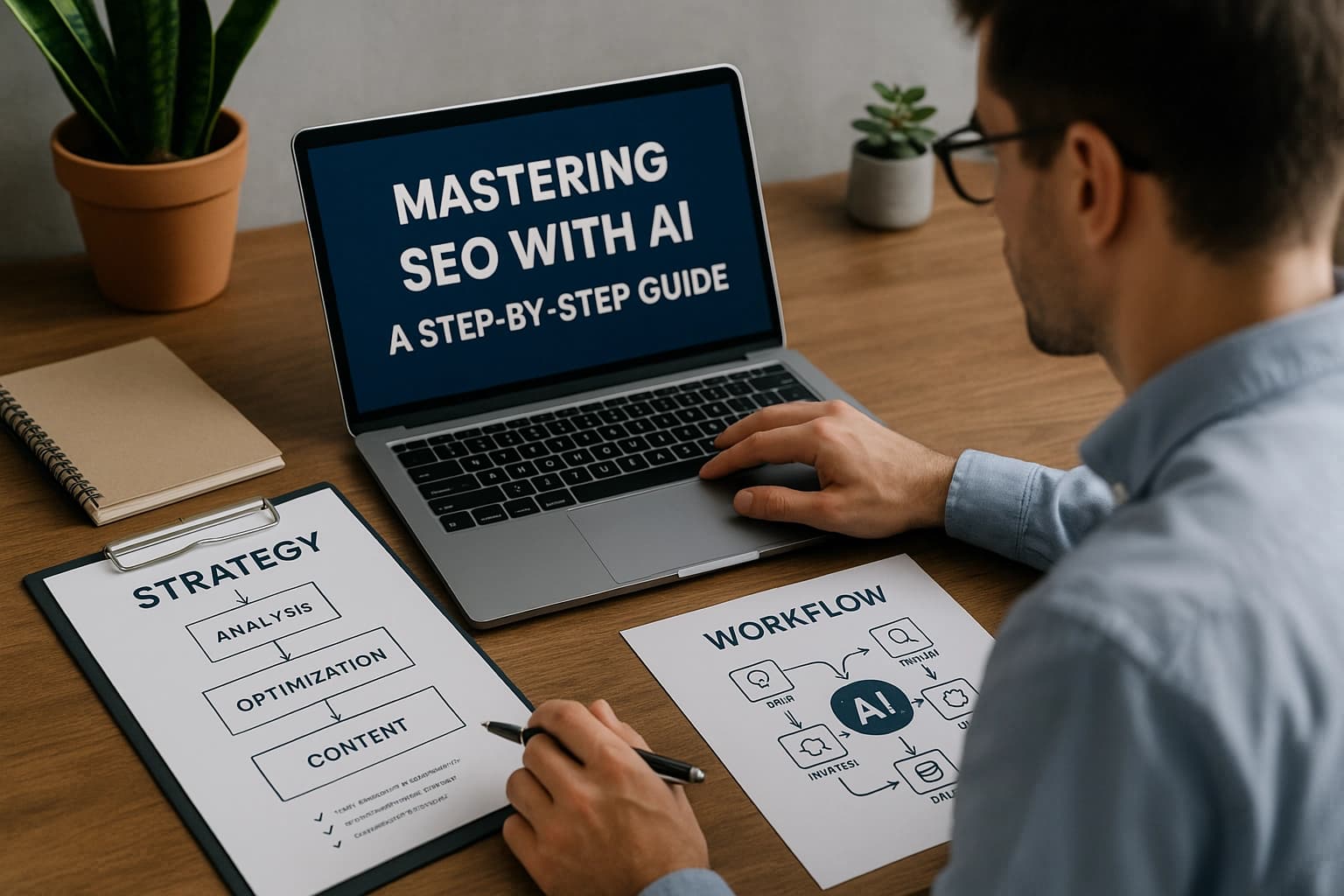
AI is not a shortcut. It is a force multiplier for SEOs who know what to ask and how to measure. If you have the fundamentals in place and want to scale quality without sacrificing strategy, you are in the right place.
This step-by-step guide shows you how to use ai for seo content creation, from intent-led research to publish-ready pages that rank and convert. You will learn to build a repeatable workflow: choose the right models and tools; structure prompts that reflect search intent; generate briefs, outlines, and drafts grounded in SERP and first-party data; optimize titles, headings, internal links, and schema; create topical maps and clusters; and refresh aging content based on performance signals.
We will also cover evaluation and governance. Expect practical methods for fact checking, brand voice control, deduplication and plagiarism checks, prompt testing, and bias mitigation. You will see how to set KPIs, track impact across rankings and conversions, and run controlled experiments that separate noise from real gains.
By the end, you will have templates, prompt patterns, and checklists to move from idea to indexed with confidence, plus a clear framework for scaling AI-assisted content without losing editorial quality.
Prerequisites and Materials
Materials and skills you need
Before you start, ensure reliable internet and a capable computer. A modern browser, a password manager, and a spreadsheet for keyword mapping will speed up workflow. An intermediate grasp of SEO is required, including keyword intent, on-page optimization, internal linking, structured data, and how semantic search and voice queries change content planning. You should also understand how AI systems generate drafts, summarize sources, and suggest entities, so you can quality check outputs for accuracy and E-E-A-T. Adopt an analytical mindset, tracking impressions, CTR, dwell time, conversions, and backlink growth to guide iterations. With AI-written pages now appearing in over 17 percent of top search results by 2025, adopting ai for seo content creation is no longer optional.
Opinly setup and expected outcomes
Get familiar with Opinly’s toolkits for content optimization, backlink building, competitor tracking, and performance analytics in the Opinly platform overview. Then follow this quick setup to prepare your stack and expectations, 1) create an account on Opinly.ai and complete workspace settings, 2) connect your CMS, for example WordPress, Shopify, or Webflow, 3) define KPIs such as non-branded clicks, average position by cluster, and content velocity, 4) run a baseline audit and keyword gap scan, 5) schedule weekly reports and publishing cadence. Expect to automate up to 70 percent of routine tasks by 2026, freeing time for strategy and editorial quality. Success criteria in the first 60 to 90 days include faster time to publish, broader topic coverage, and early ranking lifts as pages are optimized and linked internally.
Understanding AI for SEO Content Creation
Core components and why they matter
Using AI for SEO content creation means combining machine learning with search strategy to speed up planning, writing, and optimization while improving accuracy. Core components include automated keyword research that clusters queries by intent, content generation and optimization that enforces structure and entity coverage, and continuous technical audits that flag issues like broken links and slow assets. AI also evaluates backlink profiles, spotting authoritative prospects and risky links, and analyzes user behavior to refine on-page UX. The benefits compound fast. Automated research reduces hours of manual work to minutes, improves keyword selection by mapping query intent, and adapts to algorithm shifts using real-time trend signals. This matters in a landscape where AI-written pages already appear in more than 17 percent of top results and semantic search rewards topical depth over exact-match terms.
Step-by-step: apply AI to SEO content creation
Prerequisites and materials. Connect analytics and search console, gather brand guidelines, establish a CMS workflow, and create an Opinly workspace. With What is Opinly? you can confirm setup and data sources. Expected outcome: a clean data foundation and clear governance for content at scale.
Automate keyword research and clustering. Feed seed topics, then let AI surface long-tail variants, intent categories, and seasonality. Prioritize by potential clicks, SERP difficulty, and entity gaps. Expected outcome: a prioritized map that reduces research time by 70 to 90 percent and aligns with searcher intent.
Generate briefs and drafts with optimization. Use AI to produce outlines, target entities, FAQs, and internal link suggestions. Enforce readability, schema types, and E-E-A-T signals. Expected outcome: briefs that translate to publish-ready content in one to two iterations.
Monitor and adapt in real time. With Opinly’s SEO monitoring, track rankings, CTR, and engagement, then test titles, angles, and snippets as SERPs shift. Expected outcome: faster iteration cycles and steadier gains.
Automate technical fixes and links. Run AI audits to resolve indexing and speed issues, and use Backlink Intelligence in Opinly to find contextually relevant placements. Expected outcome: stronger crawlability and authority with minimal manual outreach.
Trends to watch
Generative AI is accelerating production, semantic optimization is essential for intent alignment, and AI-generated search overviews reward concise, answer-first copy. Structured data, voice-style queries, and ethical AI practices are rising priorities. Teams that operationalize these with AI systems, and let platforms like Opinly orchestrate monitoring and link discovery, typically scale organic traffic more predictably. Transition next into your content calendar by applying this workflow to one high-value topic cluster.
Step-by-Step Guide to Using AI for SEO
Prerequisites
Before you begin, have your keyword map, baseline analytics, CMS access, and an active Opinly workspace ready. Export 90 days of Google Search Console data to benchmark clicks, impressions, and average position. Prepare an editorial style guide and a list of trusted sources to keep AI outputs accurate. Configure conversion tracking for lead or revenue attribution. The expected outcome is a prioritized roadmap, faster production cycles, and measurable gains in rankings and conversions.
Identify SEO goals using AI insights
Use AI to cluster queries by intent and funnel stage, then size opportunities by demand and difficulty. Set specific targets, for example, a 20 percent lift in organic sessions for a category by capturing one hub and five supporting how-to articles. AI content now appears in more than 17 percent of top results, which means data backed targeting is essential to compete. Document KPIs, timelines, and weekly content velocity so production aligns with goals.Leverage Opinly for automated content generation
In [AI's transformative role in automated SEO](https://opinly.ai/blog/ai-optimization/automated-content-seo) you can see how automation accelerates briefs and drafts while preserving intent coverage. Create a project in Opinly and provide target keywords, audience segments, and brand voice. Generate outlines, FAQs, and schema suggestions, then schedule publishing to match search interest spikes. For example, a cluster on “B2B analytics dashboards” can be produced in a single day, from brief to CMS ready draft.Optimize content using AI-driven analytics
Opinly highlights on-page gaps such as weak semantic coverage, thin headings, or missing entities, and suggests revisions to titles, meta descriptions, and internal links. Use engagement signals like scroll depth, dwell time, and CTR to test variants. Add expert quotes, expand sections that users linger on, and insert step lists where readers stall. Reprocess the page to validate intent alignment and entity coverage.Conduct technical audits and fix issues with AI
Run an automated crawl to flag Core Web Vitals issues, heavy scripts, orphaned pages, 404s, and 301 chains. Apply fixes such as image compression, lazy loading, canonical tags, and refreshed XML sitemaps, then redeploy. Validate improvements with lab and field data to ensure real user gains. Teams often see faster indexing and reduced crawl waste within the first week.Track performance metrics effortlessly
Monitor real time dashboards for rankings, topic coverage, and content velocity in the Opinly live view. Compare pre and post metrics such as organic clicks, conversion rate, and average position, and attribute wins to specific changes. Set alerts for swings in impressions or CTR to trigger rapid iteration. Use share of voice by topic to select the next cluster to publish.
Executed together, these steps scale ai for seo content creation with precision, improving output speed, intent coverage, and durable organic growth.
Integrating AI Tools into Your SEO Strategy
Materials needed for integration
Have export access to Google Search Console and Analytics, your CMS, and a crawl snapshot for benchmarks. Prepare a current keyword map with clusters, a list of priority pages, and a content inventory that flags gaps by funnel stage. Set clear objectives, for example increase non‑brand clicks by 20 percent in 90 days, to evaluate AI impact against manual baselines. Create a QA checklist to enforce tone, compliance, and E‑E‑A‑T before anything ships. Expected outcome, a controlled environment that isolates AI contribution to rankings, content velocity, and technical fixes.
Step 1: Select and connect AI tooling
Compare manual workflows to AI‑driven equivalents, from keyword discovery and clustering to briefs and on‑page optimization. Shortlist platforms that cover semantic analysis, topical mapping, and real‑time SERP modeling, then connect read‑only access to your data sources. A curated roundup of AI search optimization tools in 2026 outlines options that accelerate research and content optimization. Use AI for SEO content creation to scale ideation and briefs, while keeping human editors for fact checking and brand voice. Expected outcome, a 2 to 3 times increase in production speed, supporting a market where AI‑written pages appear in over 17 percent of top results by 2025.
Step 2: Operationalize analytics and testing
Enable AI analytics that surface intent gaps, cannibalization, and internal link opportunities, then define decision thresholds. For example, auto‑generate briefs when a cluster hits 500 monthly searches and you lack a ranking URL, or trigger schema deployment when FAQs are detected. Validate recommendations with a weekly control group, maintain manual variants for A or B testing, and document wins. A guide to the best AI powered SEO tools for agencies in 2026 highlights predictive features useful for forecasting. Expected outcome, faster iteration cycles and earlier detection of ranking inflection points.
Step 3: Build sustainable, long‑term tactics with Opinly
Adopt semantic search workflows, voice query coverage, and structured data at scale, and schedule refreshes every 90 days for decaying pages. Opinly automates site audits, content generation, backlink building, and performance tracking, acting like a 24 or 7 SEO team trusted by 15,000 plus marketers and brands like Bosch and Gymshark. Connect your CMS, run the automated audit, deploy fix tickets, then publish AI‑assisted briefs with human edits and internal linking recommendations. Monitor uplift in clicks, impressions, and Core Web Vitals, and expand winning topic clusters via AI topical maps. Expected outcome, compounding authority growth and durable traffic gains supported by faster production and consistent technical quality.
Troubleshooting Common AI SEO Issues
Prerequisites, materials, and expected outcomes
Before you troubleshoot, gather access to Google Search Console, analytics, your CMS, server logs, and your Opinly workspace. Add a crawler snapshot, a schema validator, and a simple spreadsheet to track fixes and results. Set a baseline for impressions, clicks, and rankings for your top 50 pages, include Core Web Vitals and indexation status. The expected outcome is a measurable reduction in AI output errors, faster content throughput, and steadier rankings despite algorithm shifts. With AI content present in roughly 17 percent of top results by 2025, tightening your workflow ensures your pages stand out for accuracy, freshness, and intent alignment.
Step-by-step troubleshooting and optimization
Unify data and tagging. Standardize analytics events, consolidate keyword and performance data into one source of truth, then reconcile naming conventions and UTM rules. This prevents AI models from learning from fragmented inputs and aligns outputs with business goals. For a checklist, see AI SEO implementation best practices.
Stabilize against algorithm volatility. Monitor weekly deltas for affected URLs, then prioritize updating evergreen content with new sources, expert quotes, and refreshed FAQs. Track changes with annotations so you can attribute ranking recovery to specific edits.
Counter zero-click behavior. Mark up pages with structured data, surface concise facts, and add scannable takeaways that AIs can cite. Target questions your audience asks and include named entities and dates, which increases snippet eligibility, as noted in 2026 AI SEO trends.
Add human-in-the-loop QA. Use AI for drafts, then require editorial review for truthfulness, brand voice, and E-E-A-T checks. Spot check claims, add primary data or quotes, and align headings to search intent variants.
Maximize tool efficiency. Create prompt templates for briefs, outlines, and FAQs, and automate technical audits, internal links, and meta optimization. Measure time saved per page and uplift in click-through rate to iterate your prompts.
Leverage Opinly support. Ask support to validate your keyword map, audit schema conflicts, triage crawling or duplication issues, and recommend link opportunities. Opinly can also set alerts, repair broken internal links, and tune your AI configurations so output quality remains consistent as your library scales.
Conclusion: Embracing AI for Future SEO Success
If there is one takeaway from integrating AI across SEO, it is speed aligned with strategy. Teams that use ai for seo content creation ship briefs, outlines, and first drafts in hours, then optimize for semantic intent, voice queries, and structured data. AI-written pages now appear in over 17 percent of top search results, growing from 2.27 percent in 2019 to 17.31 percent in 2025, which raises the bar for consistent quality at scale. AI also serves as an ideation partner and auditor, clustering topics, mapping entities, and flagging technical gaps. For a broader outlook on where this is heading, see this perspective on how AI is changing content strategy in 2026. With Opinly, you can operationalize this end to end, turning insights into published, interlinked, and monitored assets.
Next steps checklist
Prerequisites: Access to Google Search Console and Analytics, CMS permissions, an active Opinly workspace.
Materials: Keyword map with clusters, recent crawl snapshot, editorial calendar.
Expected outcome: A 30 day AI assisted content sprint that lifts impressions, CTR, and internal link depth.
Open Opinly, run an audit, and capture baselines for impressions, CTR, and pages indexed.
Generate semantic clusters and briefs, include entity coverage, voice search FAQs, and schema for each target.
Produce and publish 4 to 8 pages per cluster, add internal links, optimize titles and meta, and schedule updates.
Review weekly, compare wins and losses, adjust prompts and thresholds, and expand clusters that show traction.
Get started with Opinly to put your traffic on auto-pilot
Don't wait for the perfect moment. Start building your SEO and LLM presence today with Opinly.