How to Optimize Conversions for Maximum Impact
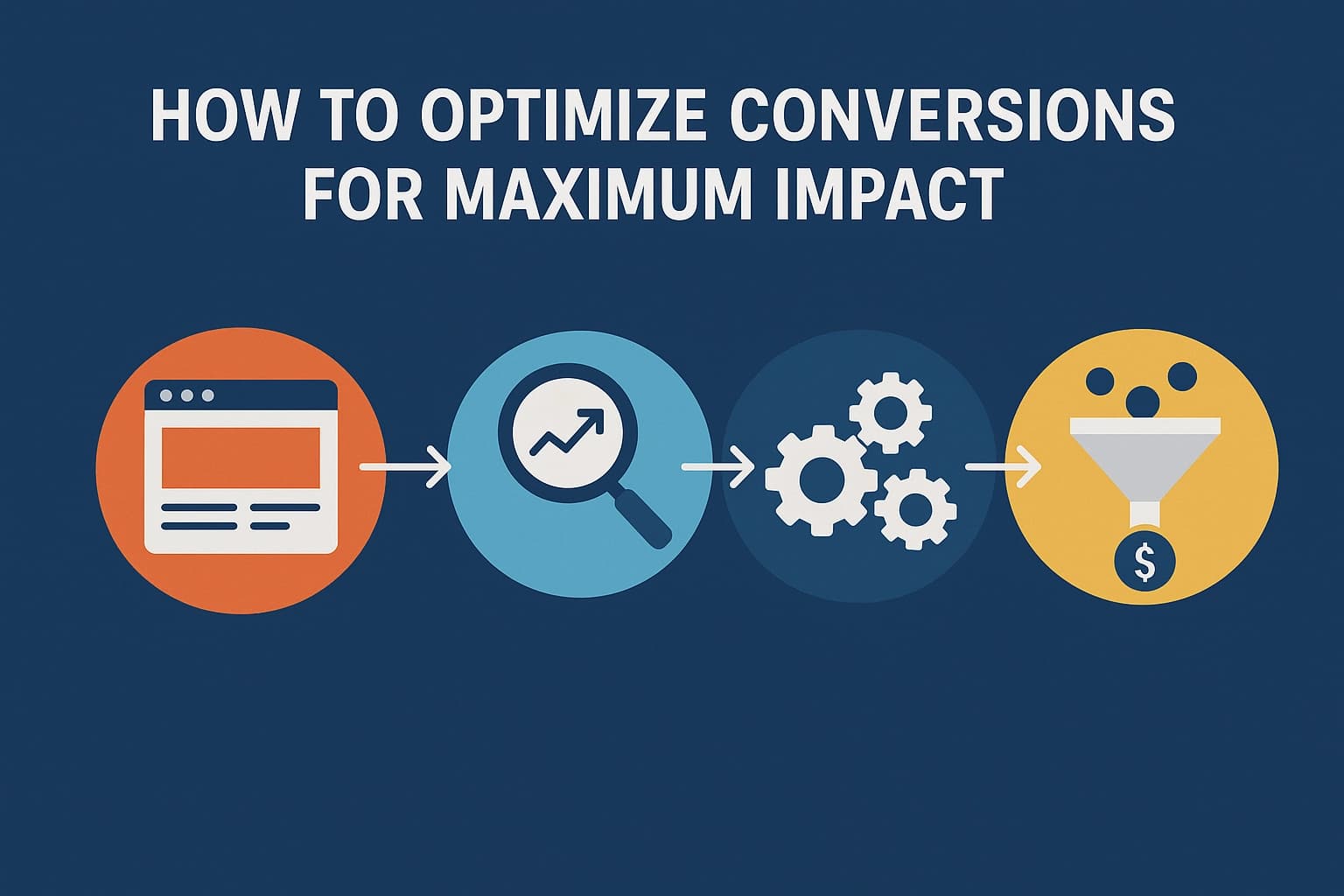
If your traffic chart looks healthy but revenue feels stuck, you’re not alone. For many teams, the constraint isn’t acquisition—it’s what happens after the click. This how-to guide will show you how to approach optimizing conversions with a structured, repeatable process that turns more visitors into customers without relying on guesswork.
You’ll learn how to baseline your funnel, pinpoint the highest-leverage drop-off points, and prioritize ideas by expected impact and effort. We’ll cover message–market alignment, offer clarity, and friction mapping across critical touchpoints—landing pages, product detail, and checkout. You’ll also get practical tactics for improving forms, microcopy, page speed, and trust signals that collectively move the needle.
Because rigor matters, we’ll walk through crafting testable hypotheses, sizing experiments, and interpreting results to avoid false positives. You’ll see when to personalize experiences versus standardize, how to use analytics to diagnose intent, and how to create a cadence for continuous iteration. By the end, you’ll have a clear playbook for optimizing conversions that you can apply immediately—and a framework to keep compounding results over time.
Understanding the Importance of Conversion Optimization
Why conversion optimization matters in 2025
Optimizing conversions is one of the fastest, most cost-efficient ways to grow in a market where ad costs, privacy changes, and competition make every visit count. Rather than buying more traffic, conversion rate optimization (CRO) compounds the value of the traffic you already have, improving revenue, lead quality, and customer engagement simultaneously. Proven practices—A/B testing, persuasive landing page copy, engaging CTAs, and credible design—help you isolate what truly moves users to act. With mobile now the dominant browsing context, fast load times and intuitive navigation aren’t optional; they directly influence conversion and retention. Meanwhile, AI-driven personalization is maturing, enabling dynamic messaging, product recommendations, and timing that align with individual user intent to lift performance across the funnel.
Quick start: quantify impact in 5 steps
Prerequisites and materials: access to GA4 and CRM/BI data, a testing tool (Optimizely/VWO), heatmaps/session replay (e.g., Clarity/Hotjar), PageSpeed Insights, and at least 1–2k monthly visitors per testable page.
Define a primary conversion (e.g., purchase, demo request) and a secondary engagement metric (e.g., scroll depth) to guard against false positives.
Establish a baseline: export 30–90 days of conversion, revenue per visit, and device split to size potential gains.
Prioritize pages by impact using an ICE/RICE score (traffic x intent x friction), starting with top-funnel landing pages and checkout/pricing flows.
Form hypotheses from user behavior: analyze funnels, session replays, and click maps to pinpoint abandonment and confusion.
Launch an A/B test with one clear change (value proposition, CTA, form friction, or trust signal), run to statistical power, and calculate revenue uplift to validate ROI.
Benchmarks to set expectations
In 2025, the average website conversion rate across industries is roughly 2.9%, with notable variation by sector and funnel complexity. Professional services tend to outperform the mean, often above 2.9%, aided by high-intent lead capture and consultative offers. E-commerce can materially improve conversions by optimizing checkout—reducing steps, surfacing trust badges, and highlighting reviews—to remove hesitation and increase completion rates. Mobile deserves special attention: responsive design and sub-2.5s load times typically yield measurable gains as users abandon slow, cluttered pages. For landing pages, align the hero value proposition, social proof, and a single primary CTA; reference best practices like those outlined by CRO landing page strategies. Combined with AI-driven personalization and disciplined testing, these benchmarks help you set realistic goals before diving deeper into your funnel.
Preparing for Conversion Optimization Success
High-ROI conversion work starts with readiness. Establish clear goals (e.g., demo requests, free trials, checkout completions) and document your baseline; the average conversion rate hovers around 2.9%, but your target should reflect your industry and funnel stage. Define success metrics (primary and guardrail KPIs), segments (new vs. returning, mobile vs. desktop), and decision thresholds. Prerequisites: clean analytics, event tracking, and a consent mechanism for data collection. Materials needed: an analytics suite, A/B testing platform, heatmaps/session replay, tag manager, speed/performance tools, a CRM/CDP for first-party data, and design/dev support.
Step-by-step setup for CRO readiness
Assemble your CRO toolkit and instrumentation. Use product analytics (e.g., Mixpanel/Amplitude) to map key events, heatmaps/session replay (Hotjar/FullStory) to understand behavior, and Lighthouse/PageSpeed Insights to harden mobile speed and responsiveness. Implement a tag manager and a QA checklist to validate events across devices; prioritize landing pages and checkout where value propositions, clear CTAs, reviews, and trust badges drive outsized impact. Expected outcome: visibility into drop-offs and a prioritized test roadmap tied to revenue.
Operationalize A/B testing as your foundation. Write hypotheses that connect user insights to outcomes, choose a single primary metric, and calculate required sample size and run time to avoid false positives; avoid mid-test peeking and stop rules without statistical backing. Start with high-impact elements—headlines clarifying value, CTA copy/color/placement, and form friction—referencing proven conversion rate optimization best practices for 2025. Expected outcome: a steady cadence of validated wins that compound, with industry variation (professional services often exceeding 2.9%) guiding benchmarks.
Activate first-party data for personalization. Unify consented data in a CDP/CRM to build behavioral segments (e.g., high-intent browsers, cart abandoners) and orchestrate tailored messaging across email, on-site modals, and ads. Use AI to generate audiences, recommend content/products, and predict churn, and ensure mobile-specific experiences (e.g., one-tap CTAs, wallet payments) to reduce friction. In e-commerce, personalize checkout with dynamic shipping estimates and display relevant reviews to build trust. Expected outcome: higher engagement and conversion lift from relevance rather than spend.
Transition smoothly into execution by selecting your first three tests and scheduling cross-functional QA.
Implementing a Step-by-Step Conversion Optimization Strategy
Prerequisites and materials
Before optimizing conversions, confirm measurement and infrastructure. Define one primary conversion (e.g., trial start, checkout complete), baseline it against the ~2.9% average, and note industry variance (professional services often exceed that). Ensure analytics coverage: product analytics for funnels, GA4 for attribution, heatmaps/session replay for behavior, and event tracking for micro-conversions. Prepare an experimentation stack (feature flags, client- and server-side testing), a design system for rapid UI changes, and a QA checklist for cross-device validation. Create a prioritized backlog of friction points (e.g., slow mobile LCP, ambiguous CTAs, checkout distrust).
Step-by-step CRO framework
Diagnose: Map funnels and quantify drop‑offs by device and segment; watch 15–20 session replays per key step. 2) Hypothesize: Tie problems to causes (e.g., “cart abandonment due to trust gaps”) and expected impact. 3) Prioritize: Use ICE/PIE scoring and set a minimum detectable effect and sample size. 4) Test: Ship the smallest viable change—e.g., add prominent reviews, security badges, and delivery dates to checkout—to validate lift. 5) Analyze: Track primary lift plus secondaries (AOV, bounce, scroll depth) and run QA on edge cases. 6) Iterate and scale: Promote winners, queue follow-ups (e.g., payment options, guest checkout), and document learning.
Dynamic testing beyond A/B
Use multivariate tests when interactions matter (headline × hero image × CTA). For faster learning, apply multi‑armed bandits to auto‑allocate traffic to winners in near real time, then confirm with a fixed‑horizon test. Consider Bayesian or sequential methods to reduce test duration without inflating false positives. Deploy AI-driven personalization (e.g., content blocks tailored by intent or lifecycle), while protecting against overfitting with holdout groups. Prefer server‑side tests for performance-critical flows; reserve client‑side for copy and layout.
Landing page and mobile optimization
Clarify value propositions above the fold, keep CTAs visually dominant, and layer social proof (ratings, counts, and recent reviews) near decisions. On mobile, target sub‑2.5s LCP, 48px tap targets, sticky CTAs, and simplified nav; follow these mobile UX best practices. Compress images, lazy‑load below‑the‑fold assets, and remove render‑blocking scripts. Expect early wins from checkout trust signals and review visibility in e‑commerce; combined with mobile speed gains, teams often achieve meaningful, compounding lifts over a 6–12 week cycle. Maintain a weekly test cadence to compound learning and sustain momentum.
Harnessing AI for Personalized Conversion Strategies
Prerequisites and materials
Before applying AI to optimizing conversions, ensure clean, consented analytics/CRM data, event tracking for key actions, and a primary KPI. Equip a CDP or warehouse, an A/B/ bandit experimentation tool, and a CMS/ESP that supports dynamic content. Set mobile performance budgets (e.g., sub‑2.5s LCP) and responsive templates. Prepare content variants and a recommendation feed. Establish privacy guardrails, holdouts, and success criteria for macro and micro conversions.
Step-by-step
Identify segments and hypotheses. Use clustering (k‑means, RFM) and behavior tools (session replays, heatmaps) to reveal cohorts and friction, then tailor offers and copy. Prioritize landing pages and top entry paths with clear value propositions and engaging CTAs; size potential lift against the 2.9% average benchmark. Define segment-level metrics (demo starts, checkout progression) and minimum sample sizes before testing.
Deploy AI-driven personalization. Train a recommendation model (content/products) and an NLP intent model to trigger dynamic headlines, CTAs, and social proof. Use multi‑armed bandits to allocate traffic while keeping an A/B control for causal reads; this speeds learning. Optimize mobile delivery—lightweight components and caching—to keep experiences fast and intuitive.
Analyze and iterate. Compare uplift versus controls at 95% confidence, then roll out winners and keep a persistent holdout for long‑term impact. Inspect feature importance to understand drivers, and monitor funnel drop‑offs by device. In e‑commerce checkouts, surface trust badges and verified reviews; the Baymard Institute’s checkout UX research shows these reduce abandonment. Feed learnings into new hypotheses and seasonal models.
Expected outcomes
Teams typically see faster cycles, clearer attribution, and targeted lifts: 5–15% increases in CTR on personalized modules and measurable gains in micro‑conversions that compound into macro KPIs. Mobile users benefit most when speed and relevance combine, mirroring the shift toward responsive, high‑performance design. Industries vary—professional services often beat the 2.9% average—so calibrate targets by vertical and baseline. Over time, AI clarifies user behavior, guiding ongoing landing page, mobile, and checkout optimization. A/B testing remains the backbone, with AI accelerating insight and allocation.
Refining Your Conversion Path and Call-to-Action
Prerequisites and materials
Clean funnel analytics with event tracking (CTA clicks, form errors, exit pages)
Heatmaps/session replays to observe behavior
A/B testing platform and a design system for rapid CTA/component updates
Mobile testing devices or emulators and page-speed tooling
Optional: AI personalization engine or rules-based targeting
Expected outcome: a prioritized backlog of friction points and the ability to implement, test, and measure improvements in days, not weeks.
Step-by-step conversion path refinement
Map the current path
Action: Visualize the end-to-end journey (ad → landing page → product/pricing → checkout/form). Identify the top three drop-offs with funnel reports; validate with session replays. Example: 38% abandon at “shipping” after encountering unexpected fees.
Outcome: A focused shortlist of leaks with user evidence, not guesswork.
Simplify the journey
Action: Remove nonessential steps and fields; enable guest checkout, auto-fill, and express pay. For lead gen, cap forms to 5–7 fields and add a progress indicator. Surface reviews and trust badges near price and checkout to reduce anxiety.
Outcome: Shorter time-to-completion and fewer decision points; e-commerce typically sees meaningful gains when checkout friction and trust gaps are addressed.
Craft high-impact CTAs
Action: Use one primary CTA per view; write action + value (e.g., “Start free trial—no credit card”). Pair with a 10-word value proposition above the fold, supportive proof nearby, and contrasting, accessible color. Add a sticky mobile CTA for thumb reach.
Outcome: Higher CTA click-through via clarity, prominence, and relevance.
Optimize for mobile
Action: Prioritize sub-2s loads, responsive layouts, and 44px tap targets. Reduce modal interruptions and ensure forms support device auto-fill.
Outcome: Lower mobile bounce and improved completion as mobile usage grows.
Test iteratively
Action: A/B test CTA copy/placement, form length, sequencing, and fee transparency. Segment by device and traffic source; run to significance.
Outcome: Evidence-backed winners that outperform your baseline.
Personalize with AI
Action: Serve intent-based CTAs (e.g., pricing visitors: “Book a demo” vs. blog readers: “Get the guide”). Tailor social proof by industry.
Outcome: Higher relevance and conversion lift across segments, with industry benchmarks guiding expectations.
Conclusion with Actionable Takeaways
Effective conversion optimization blends evidence and execution. Ground decisions in behavior analytics—funnel events, heatmaps, session replays—and validate with A/B tests to find winners. Prioritize high-impact surfaces: landing pages with sharp value propositions, benefit-led CTAs, and clean design; mobile experiences with fast load times and intuitive navigation; and checkouts reinforced by reviews and trust signals. With average conversion around 2.9% and professional services above that, most teams have headroom, especially when e-commerce checkout friction is reduced. Trends amplify the basics: mobile speed/responsiveness increasingly drive lifts, and AI-powered personalization turns intent into relevant offers. Commit to an iterative cadence so learnings compound.
Quick action plan
Benchmark vs 2.9%; set a single KPI; prioritize top 5 pages.
Verify tracking, heatmaps, replays; enforce mobile LCP <2.5s and intuitive nav.
Run an A/B test on headline and CTA; segment by device.
Streamline checkout: fewer fields, autofill, reviews and trust badges; monitor drop-offs.
Personalize with AI (recommendations/prompts); ship 1–2 experiments weekly; roll winners.
Prerequisites: primary KPI, consented analytics, test governance.
Materials: A/B tool, heatmaps/replays, page-speed diagnostics, reviews.
Expected outcomes: 5–15% lift on prioritized pages within 30 days.
Get started with Opinly to put your traffic on auto-pilot
Don't wait for the perfect moment. Start building your SEO and LLM presence today with Opinly.